
What is Trauma?
Trauma can be a really elusive term to nail down. It can have a big "T" or it can have a little "t." It can be complex, it can be post-, it can be developmental. We can conflate it with other terms like "stress" and "shock." We can tie it to events that happen in someone's life instead of one's response to such events. We can call it a disorder or view it as an adaptation to one's environment, or both.
On top of all of these things, there are a plethora of formal definitions of trauma to choose from. Here are just a few:
>> An experience that overwhelms the ability of a system (individual, family, group, community, nation, etc.) to cope adaptively.
>> An extreme activation of the stress response system in an attempt to protect from perceived threat or danger.
>> A disorder that involves an inability to be in the present moment due to being frozen in the past (e.g., PTSD).
>> What happens to someone as a result of the painful event/s they have experienced; it is not the event itself.
>> When we are not seen and known; when we lose connection to ourselves, our loved ones, and the world around us.
Confused and overwhelmed yet? In light of all of these thoughts, is there a way to define trauma more simply?
At Bristlecone Therapy (BCT), we believe there is. We believe that marriage and family therapist Bonnie Badenoch gets very close to an essential understanding of trauma in her book, The Heart of Trauma (2017), where she defines trauma as:
"Any experience of fear and/or pain that doesn’t have the support it needs to be digested and integrated into the flow of our developing brains" (p. 23).
To unpack this a bit, Bonnie is stating that when we are alone--emotionally and or physically--during a time of stress, when we don't have interpersonal resources to call upon to help us make sense of a painful or fearful situation, we are forced to make sense of and attempt to digest (both emotionally and physically) the fear and pain all by ourselves. This experience is what she calls trauma.
BCT would like to state this idea slighty differently to assert that:
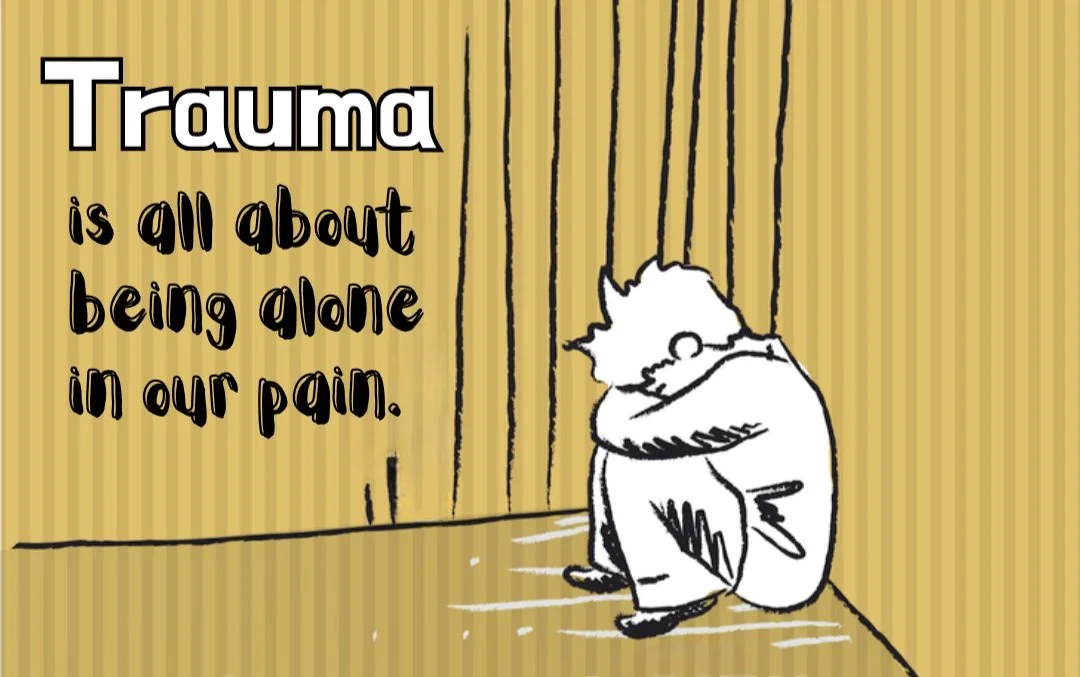
Trauma is all about BEING ALONE IN OUR PAIN.
This definition allows us to see trauma as a process; as relational; as embodied; as potentially relating to everything from teasing to tornados, from name-calling to neglect, from the absence of good things in one's life to the presence of abuse. Most importantly, this definition also allows us to see many avenues for the healing of our trauma.
So...what can be done to bring healing to trauma? More on this in future blog posts!